Thursday, February 26, 2026

Try a Woodworking Jam Session

When I was in 10th grade, I went to my friend Joe’s house. Joe was a pretty cool dude. Good looking, played the drums, effortlessly confident. He took me upstairs to his bedroom where his drum kit lived and started playing along to music blasting through the speakers of his boom box. Remember those?

Most people would call it an assault on the eardrums. I was mesmerized.

Suddenly I wasn’t in Joe’s bedroom anymore. I was on a stage. Tommy Lee was in front of me, Vince Neil was belting out Girls, Girls, Girls, and somehow I belonged there. If you don’t like Mötley Crüe, get your own fantasy!

That moment stuck with me. It was a turning point. I realized I didn’t just want to watch music happen. I wanted to be part of it.

Making It Work

Luckily, I had musicians in the family. My step-dad was in a country music band and I had a few uncles that had extra equipment laying around. Before long, an old drum set that had been collecting dust in an attic made its way into my basement. It was incomplete, mismatched, and missing hardware.

No tom mounts? No problem.

Using some of my Jersey ingenuity, I threw a ladder over a couple of garbage cans and dropped the toms between the rungs. A little rope, some wire, questionable engineering decisions, and boom, a mostly operational drum kit. I wish I had a picture of it. It was ridiculous. But it worked. I started teaching myself how to play.

Looking back, I’m amazed my mom allowed it. Acoustic drums in a basement are not subtle. And we lived in a small house in Trenton, NJ with no insulation between the basement and main floor with neighbors in close proximity. Sound just went right through ceiling and walls. But Mom always said she liked hearing it because it meant I was home and safe. As a parent now, I understand that in a way I couldn’t back then.

The Magic of a Jam Session

Not long after, I found a few friends at school and we started playing together. We weren’t good. We never would be. But that wasn’t the point.

If you’ve never played an instrument, here’s something you might not realize: there’s a huge difference between playing music you’ve memorized (or read) and creating something together in real time.

A jam session usually starts small. A guitarist plays a few chords. The bass player finds a groove underneath it. The drummer listens for the pulse and locks it in. Everyone is playing their own part, but they’re also constantly listening, adjusting, reacting.

It’s creative tension and cooperation happening simultaneously. When it clicks, it’s electric. You’re interpreting someone else’s intention in real time. You’re offering your own ideas without overpowering the whole. You’re building something none of you would have created alone.

That feeling is hard to describe. But when you experience it, you chase it.

The Woodworking Version

Years later, I realized I’ve been chasing that same feeling in the shop. I don’t think we talk enough about collaboration in woodworking. A lot of designers operate solo. And that makes sense. Designing is personal. It’s vulnerable. It’s easy to want full ownership of the idea. But that’s rarely my approach.

I consider myself an average designer. Most of what I create is derivative in some way, influenced by the thousands of pieces I’ve studied and the countless woodworkers I’ve learned from over the years. So why would I pretend my ideas spring from a vacuum? If anything, I want input.

Not from just anyone, of course. I’m selective. I trust experience. I value thoughtful critique over unsolicited opinion. And I care deeply about aesthetic alignment. But when I find the right collaborator, magic happens.

My SketchUp Jam Partner

One of those collaborators has been Brian Benham. For years, Brian helped bring Wood Whisperer designs to life. He created plans, built SketchUp models, and contributed to the design credit on many Guild projects. If you’ve taken a Guild course, you’ve seen his fingerprints. Brian even has several courses in the Guild including one on designing in Sketchup.

Here’s how it usually works. I send Brian everything I have, measurements, constraints, angles, reference photos, and my very imperfect SketchUp model. I’m competent enough in SketchUp to get things 50 to 60 percent there. An approximation, but not refined.

Then we hop on Zoom. Brian opens SketchUp and shares his screen. And this is where it feels exactly like a jam session.
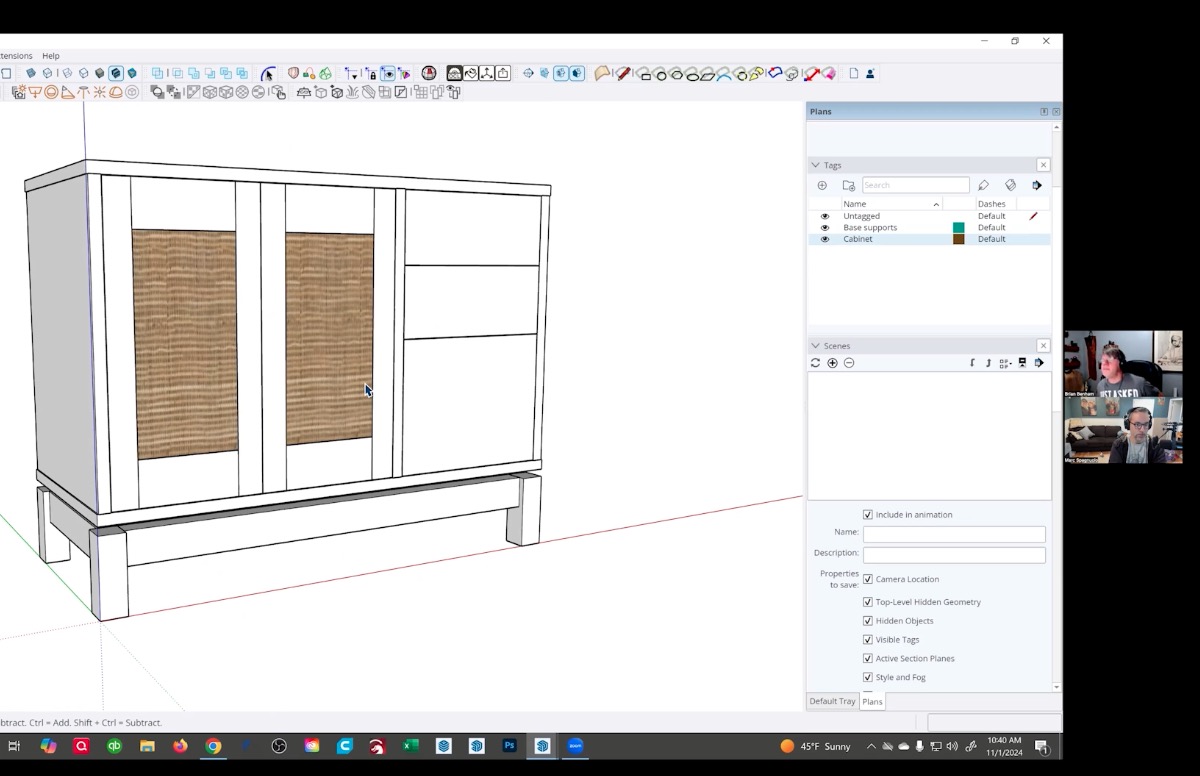
Collaborative Zoom Call

I’ll say, “What if we soften that curve?” He draws it instantly.
“What if that leg tapers a little more aggressively?” Done.
“Can we see what it looks like with a different angle?” On the screen in seconds.

But he’s not just drafting my ideas. He’s reacting. Suggesting. Improving.

“Have you considered lowering the rail?”
“That proportion feels heavy.”
“What if we echoed that angle here?”

Back and forth. No ego. No defensiveness. Just exploration.

I’ve done this with Brian 20 or 30 times over the years. Just recently, we did a quick consult on a table I’m building for my buddy Jason. The concept wasn’t fully formed, but after an hour of jamming, it was clear enough to move confidently into prototypes and shop work.

That’s the payoff. Before a single board is cut, the design is stronger.

Why This Matters

Collaboration does a few powerful things:

  • It confirms good instincts
  • It exposes weak ones
  • It prevents expensive mistakes
  • It accelerates refinement
  • It pushes you beyond your default thinking

Most importantly, it reminds you that woodworking doesn’t have to be a solitary pursuit.

We romanticize the lone craftsman. But historically, workshops were collaborative spaces. Apprentices, masters, peers, all working, observing, critiquing. The modern version might just be Zoom and SketchUp (or your software of choice).

Try Your Own Jam Session

I don’t know what kind of access you have to other woodworkers. Maybe it’s a friend at the local woodworking club. Maybe it’s someone in the Wood Whisperer Guild. Maybe it’s me and you’ve hired me for a consultation.

But if you ever get the chance to “jam” on a design together, take it. Share your rough sketch. Share your half-baked idea. Get on a call. Let someone else poke at it. With the right person, it’s exhilarating. Two minds exploring what-ifs. Throwing out ideas. Refining proportions. Building something neither of you would have created alone.

Maybe someday I’ll reach a point where I don’t want outside input. Maybe I’ll be so confident that another opinion would only muddy the water. But I doubt it. Because for me, woodworking isn’t just about building furniture. It’s about making something better than my last project and constantly trying to fill gaps in my woodworking education. Other people with unique perspectives and backgrounds are a great cheat code for achieving that goal.

And that’s music to my ears!

The post Try a Woodworking Jam Session appeared first on The Wood Whisperer.


from The Wood Whisperer https://ift.tt/5rgIaZN
via IFTTT

Friday, February 20, 2026

Dried glue on your clamps? Do this! (Plus 4 More Shop Questions)

Home Shop vs Commercial Space, What Are the Real Tradeoffs?

One of the biggest transitions a woodworker can make is moving from a home shop to a commercial space. I’ve worked in both, and the “right” choice depends heavily on your stage of life and business.

When my kids were little, having a shop at home was invaluable. I could work during naps, pop in after bedtime, and stay close to family. That flexibility is hard to beat.

As they got older, though, the shop became more of a distraction. I started craving separation between work and home life. Moving into a commercial space gave me clearer boundaries and a more professional environment for clients and guests.

But there are tradeoffs:

  • A basement shop has no rent, no commute, and bundled utilities.

  • A commercial space means fixed monthly expenses and additional insurance.

  • Security becomes a real consideration.

  • DIY projects at home become more complicated when your tools aren’t nearby.

On the flip side, a commercial shop allows for growth, better workflow, and room for additional help. For me, it was the right move, but it’s not a universal answer.


How to Make Kapla-Style Blocks from Scrap Wood

Kapla-style planks follow a precise 15:3:1 ratio. If you’re making your own from leftover lumber, accuracy matters. Here’s the general order of operations I recommend:

  1. Mill to thickness first
    Start with a flat, jointed board and plane it down to your target thickness. Sneak up on the final dimension using calipers. A planer will get you close, and a smoothing plane can dial it in perfectly.

  2. Rip into strips
    Use the bandsaw to cut slightly oversized strips. Then plane them down to final thickness just like you did with the full board.

  3. Cut to length with a stop block
    Use a miter saw with a stop block for repeatable accuracy. If you need micro adjustments, nudge the stop block incrementally until you hit your exact measurement.

Batch your work. Mill all boards first, then rip all strips, then crosscut all pieces. This keeps everything consistent. If you’ve ever made edge banding or thin slats, the process is very similar.


Are Table Saw Cuts Really “Glue Ready”?

Here’s the important distinction: Glue ready and finish ready are not the same thing.

Most power tools in my shop produce surfaces that are glue ready, meaning flat and clean enough for a strong bond. But that doesn’t mean they’re ready for finish.

  • A bandsaw surface often needs additional work before it’s even glue ready.

  • A jointer surface is usually glue ready, but may show subtle cutterhead striping under finish.

  • A planer can leave a very clean surface, but I still prefer light sanding, scraping, or planing before applying finish.

  • A table saw cut is typically glue ready, assuming a sharp blade and proper setup, but faint blade lines are almost always present.

Those small lines might not look like much, but once finish goes on, they become much more noticeable. Finish highlights imperfections, it doesn’t hide them. So my general rule is simple: If it comes off a power tool, it’s probably glue ready. It’s rarely finish ready. A few extra minutes of post-processing can make a big difference in the final result.


The Best Way to Remove Dried Glue from Clamps

Let’s be honest, prevention is ideal. Wax your clamp bars. Lay down paper or tape during glue-ups. In theory, that’s great advice. In practice, most of us don’t bother. Fortunately, most dried glue pops off easily with a putty knife. For more stubborn buildup, there’s a simple solution you probably already have in your kitchen: vinegar.

You have two options:

  • Wrap the clamp bar in a vinegar-soaked rag and let it sit.

  • Create a PVC pipe “bath” and soak the bar directly.

After soaking, the glue softens enough to scrape off easily. One warning: vinegar can dull the finish on shiny clamp bars. If aesthetics matter to you, keep that in mind. Simple, inexpensive, effective.


Do Acoustic Panels Actually Reduce Shop Noise?

This is where things get misunderstood. Acoustic panels do not soundproof a room. They won’t stop noise from escaping your shop. What they do is reduce reflections inside the space. By absorbing mid and high frequency sounds, they prevent harsh reverberation and make the room feel calmer and more controlled. Your recordings will sound dramatically better. If you’re building your own panels:

  • Use a quality absorber like 2-inch Rockwool.

  • Wrap it in acoustically transparent fabric.

  • Mount panels with an air gap roughly equal to the panel thickness.

  • Consider staggering them to reduce reflected sound paths.

If you want a full walkthrough, I’ve got a detailed video showing how I built mine.


Want Your Question Featured?

If you’d like your question answered in a future Ask TWW episode, join us in the YouTube membership area or on Patreon. I answer every question submitted, and occasionally feature a few in the show.

Thanks to all our supporting members for helping us keep this thing going.

The post Dried glue on your clamps? Do this! (Plus 4 More Shop Questions) appeared first on The Wood Whisperer.


from The Wood Whisperer https://ift.tt/ET7pOMs
via IFTTT

Friday, January 30, 2026

This Simple Upgrade Makes Parallel Clamps Way Better

Parallel clamps are one of the most commonly used clamping tools in a woodworking shop. They’re versatile, strong, and ideal for panels, casework, and glue-ups of all sizes. In spite of how much I rely on them, they aren’t perfect.

The Problems

Parallel clamps feature hard plastic faces. While durable, that material creates two common problems that nearly every woodworker has experienced. First, the hard jaws can dent the workpiece when excessive pressure is applied, especially on softer woods or already-machined surfaces. Second, the smooth plastic offers limited grip, which can allow the clamp to shift during glue-up, requiring extra adjustments and attention.

The Solution

To fix both of these problems, we can add a softer, slightly compressible pad to the clamp faces. This reduces the chance of denting and allows the clamp to hold more securely with less force. The added grip also helps prevent pieces from sliding out of alignment as clamping pressure increases.

The material I’m using for this is rubberized cork sold by my buddy Andy at In-Kleind.com.

  1. Cut the material to shape. I made a template using this DXF file. You can also purchase a template from us if you like. Both are available in our store!
  2. Scrape any glue off the clamp head and give it a light sanding with 120-150 grit paper.
  3. Clean the surface using a solvent like denatured alcohol, lacquer thinner or acetone.
  4. Apply contact cement (https://amzn.to/4rl6gCq) to both the clamp head and the clamp pad. Allow to dry 15-20 minutes.
  5. Carefully press the clamp pad onto the face of the clamp. Keep the clamp under pressure for 24 hrs.

A Time Saver: True Grip Clamp Pads

If you want to save yourself a bunch of time, consider purchasing True Grip Clamp Pads.

In the end, the takeaway is simple. Parallel clamps are already excellent tools, but with a small modification to the jaw surface, they become easier to use, more forgiving, and more effective. If you want to improve your parallel clamps and get better results from the ones already in your shop, this step-by-step approach shows exactly why the upgrade works and how it improves everyday woodworking tasks.

The Wood Whisperer is sponsored by Woodcraft!

Woodcraft

Looking for more information on parallel clamps? Check out these videos and articles:

The post This Simple Upgrade Makes Parallel Clamps Way Better appeared first on The Wood Whisperer.


from The Wood Whisperer https://ift.tt/5ea8JzA
via IFTTT

Friday, January 16, 2026

Small Tweaks, Big Results | Shop Layout

Looking to grab some of that sweet Woodworker Fuel Coffee? Get it while you can! 

As a kid, I loved rearranging my bedroom. It wasn’t about buying new furniture or adding more stuff, it was about seeing how small changes could completely change how the room felt and how I used it. That same instinct has followed me into the shop, especially when it comes to shop layout.

Over the years, I’ve learned that shop efficiency rarely comes from major overhauls. More often, it comes from stepping back and asking one simple question: does this shop layout actually reflect how I work?

The Problem With “Good Enough” Layouts

Most shops evolve organically. You get a new tool, you find a place where it fits, and you move on. Over time, that approach leads to friction you may not even notice anymore, extra steps, awkward material handling, and work that feels harder than it should.

Nothing in my shop was “wrong” on its own. But when I looked at the space as a system instead of a collection of tools, it became clear that the shop layout and overall flow could be better.

Designing Around Workflow, Not Tools

One of the biggest mindset shifts is realizing that tools shouldn’t dictate layout, process should. A good shop layout is built around how material moves, not just where machines happen to fit.

I looked at how material actually travels through my shop, from rough stock to milling, from machining to assembly, and finally to finishing. Once you map that out, inefficiencies become obvious. Machines that made sense individually didn’t always make sense together.

By adjusting locations slightly, not dramatically, I was able to reduce unnecessary walking, improve material flow, and create clearer work zones without gaining a single square foot. These small refinements made the shop layout work with me instead of against me.

Small Changes That Add Up

What surprised me most was how minor the changes were. Moving a tool a few feet. Reorienting another. Clearing visual clutter from high-traffic areas. None of it was flashy, but the cumulative effect was immediate.

The shop feels calmer. Work feels more intentional. I have so much space for activities, and I spend less time navigating the space and more time actually building. That’s the power of a thoughtful shop layout.

Efficiency Is About Thinking, Not Space

A bigger shop doesn’t automatically mean a better shop. What matters is how well your shop layout supports your way of working.

If there’s one takeaway here, it’s this: you don’t need a full rebuild to see meaningful improvement. Thoughtful, incremental changes, guided by workflow, can produce outsized results.

Sometimes the biggest gains come from the smallest moves.

Relevant Links

The post Small Tweaks, Big Results | Shop Layout appeared first on The Wood Whisperer.


from The Wood Whisperer https://ift.tt/8ybN5Li
via IFTTT